
- Posted on
- • Computers
ATI - Canadian All-in-Wonder
- Author
-
-

- User
- seankerr
- Posts by this author
- Posts by this author
-

Do young people of today know of ATI when they see a AMD Radeon video card? And do people in general know that ATI was a Canadian based company? The last standing competitor to Nvidia graphics; ATI or, as known now- AMD Radeon.
In my time, buying ATI was seen as supporting a Canadian company VS the American ones. Yes ok... back in the days forward of early 3D graphics acceleration (Rage 128)- the drivers from them were buggy and quirky, but once you got things settled, it was a great device to use (whichever product you chose along its lineup).
Prior to 3D acceleration, I'd say the drivers were as good as anything else. And, I'd say of that prior era- ATI cards, from ISA, to VLB, to PCI, From Wonder, to Mach, to Rage series- (and later to Radeon) innovated in terms of pioneering early video acceleration features, which were crucial for video playback on PCs. With these early products, ATI produced integrated graphics cards for PC manufacturers, including IBM and Commodore, which gave them a strong presence in the market.
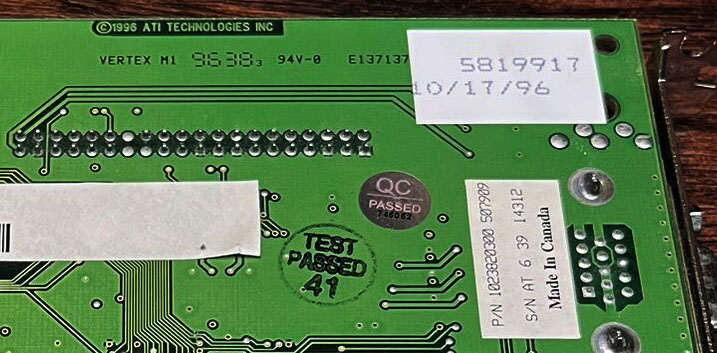
ATI was first known as Array Technology Inc. and was an OEM supplier of graphics cards for PC manufacturers. But started to get into being a graphics card retailer with EGA and VGA Wonder cards. Mach8 and Mach32 introduced GUI acceleration. After the Mach series, they did the Rage series. And the first ATI card that was a stand-out (in my mind) of that line, was the Rage 128.
Just like the 486 DX2 66mhz was the first CPU I saw that was "so fast" it needed a heatsink, the Rage 128 GPU also needed a heatsink. Actually it needed a bigger heatsink than it came with initially, as it regularly overheated and I remember it being a catalyst for the computer store I was working at to start thinking about adding a case fan for extra cooling.
These were the days of AGP, and AGP 2X and later 4X... Rage 128 was fast at doing 3D at 32bit colour, whereas Nvidia's TNT and the Voodoo 3 operated in 16bit colour.
One innovation came around with the introduction of the popular All-In-Wonder series which debuted with the Rage chip. These cards ran at reduced clock speeds (with some exceptions), but offered a TV tuner built-in along with video in/out, remote control, FM radio and built in TV guides. We take a lot of these things for granted now- but back then having even a TV output option was highly unusual. With the AIW, you could watch TV (and set the video to be your wallpaper!), record it- do video edits. As I remember, working at a small computer store- it was a very popular and affordable option for those that wanted to have the most options in one card.
At the time when the industry was building out the foundations of 3D acceleration, ATI released the Rage Fury MAXX. A dual GPU card that seemed absolutely crazy and over the top, but also very cool. It was priced at $299 USD back in 1999 ($575 in 2025 dollars). You can read about its details elsewhere but it was a device stuck using Windows 98/ME, and had other reasons for failing. I remember thinking wow, this is so advanced, one of those things you can't believe they actually were brave enough to bring to market. It made me think, what game could even make use of all this power?
The next gen for ATI was code named Rage 6. Renamed Radeon when released. Sunnyvale, California based AMD acquired ATI in 2006 for 5.4 billion, and ATI brand was phased out in 2010.
AMD, then the second-biggest computer chip company in the world, had promised to increase research and development spending in Canada beyond what ATI had spent, and would nominate a Canadian for election to AMD's board of directors within the next five years.
Analysts said the deal would broaden AMD's product range as it tried to compete against global chip leader Intel Corp.
We have to also at least mention Matrox here, as they also were a major Canadian graphics card company. Matrox still makes cards based on Intel's Arc GPUs.