
- Posted on
- • Technology
Encyclopedias to Wikipedias
- Author
-
-

- User
- seankerr
- Posts by this author
- Posts by this author
-
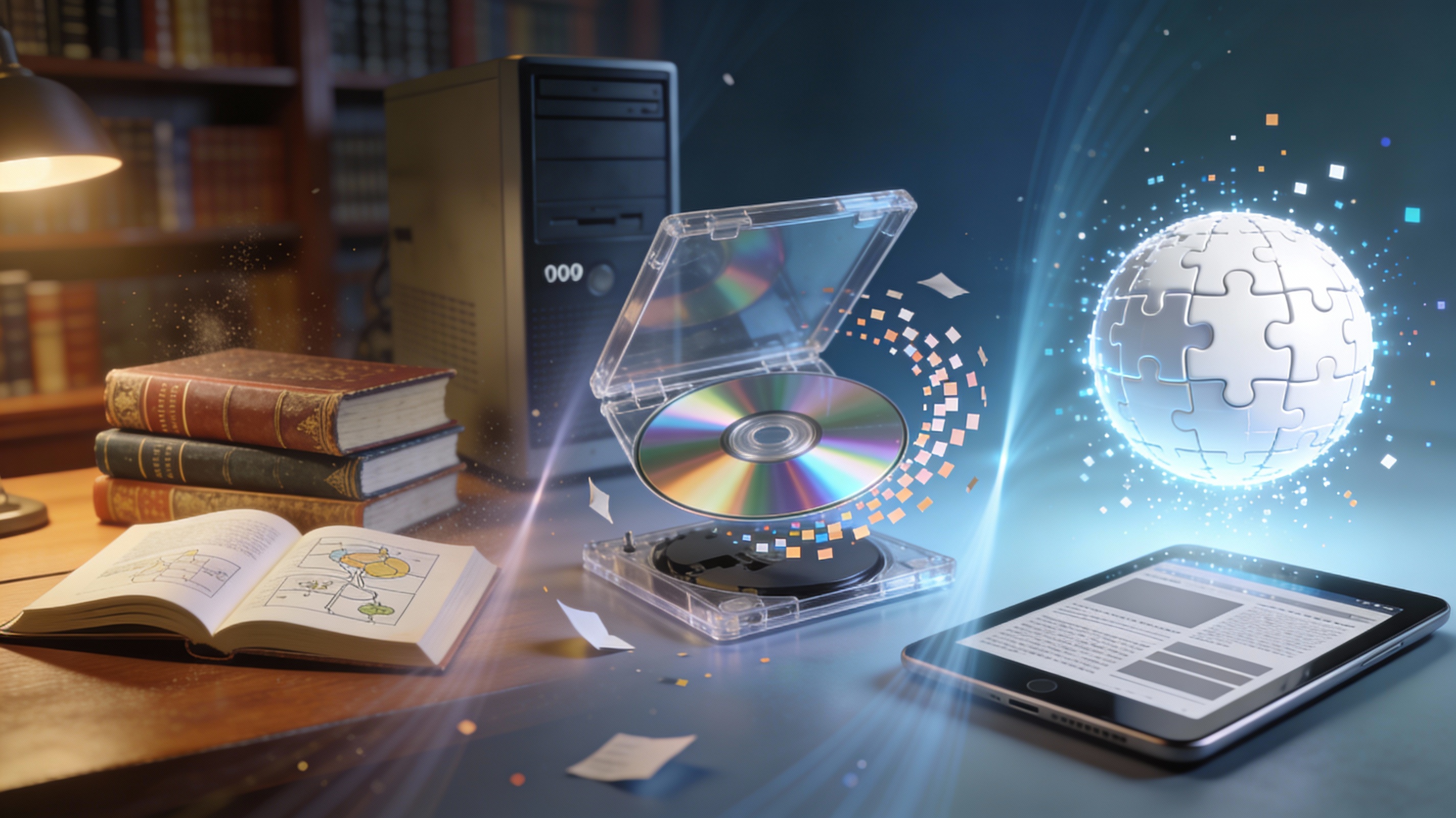
Yes, I am of the generations that actually used an encyclopedia-set at home to look up curiosities, and to research for school projects. There was no internet available to me, no Google, no Alexa, certainly no AI to ask. I myself was the Google, searching through information that was published from a few years before I was born.
As I understand it- generally if your parents had the money- they'd buy an encyclopedia set at or around your birth, as was the case for me. This way, as you grew up, going through school, you'd have some authoritative overviews of established knowledge on any topic, serving as a good starting point for any research.

Now lately, I've been collecting old CD-ROM based encyclopedias. I have a few versions of Microsoft Encarta from the later 90s, and Comptons from the mid 90s. I collect these because when they were new- they were real wonders in their own right, and also showcased what a multimedia computer could do.
Sights and sounds, search ability, and interactivity of that new format displayed capabilities of cutting edge computers of the time. The then relatively new ability to store vast amounts of data on CD or DVD formats allowed you to hold a small library of information in your hand.

This was an interesting moment in time when the internet wasn't as ubiquitous as it is now, and wasn't necessarily capable (or at least uniformly capable) of supporting what was being made available on the CD-ROM. Though certainly later versions of Encarta etc did incorporate online features.
I recently heard Neil deGrasse Tyson say: 'there are still people alive today that remember what it was like to live without the internet'... Noting that before the internet (and before CD-ROMs) if one wanted to research a topic- unless you had a book on hand in your home, you'd start by journeying to your local library. Then you'd find the particular section, and find a particular book, and look at its table of contents to find your topic.
If you were lucky enough, you MIGHT have an encyclopedia set at your home. Something your parents may have been coerced into buying by a traveling sales person- who would ask up to $3000 (in the 1980s) for an encyclopedia set. Maybe you would have a prior version of a set from an earlier decade/year with information that could be outdated by the time you went to look up the info you were interested in.
From that, moving to Encyclopedia on CD - you had the advantage of searching for a topic from a prompt. You had the ability to see photos as you would in a book, but also audio and video. There was an effort to include interactivity through learning games, dynamic timelines, virtual tours, hyperlinks within articles, and more frequent updates. There was also an advantage of less cost, the CD would cost roughly $150-$300 initially but later would usually be included for 'free' with a new computer purchase.

That said on the cost- you still needed a fairly advanced computer with CD-ROM and audio/video playback capability which not everyone had at the time. This was where I do remember my library having dedicated multimedia computers with the main use case of being a host for the encyclopedia on CD.
I have a strong sense of nostalgia for these highly curated collections of information- which came from a 'trusted' source. I know these days this type of thing tends to be looked down on. The idea of not letting "the man" or "the institutions" tell us how things are. And so we see Wikipedia, a free and collaboratively maintained encyclopedia. And the idea is it is supposed to be "source based" and then also community reviewed for accuracy. I can't help but think- what if the majority of 'experts' on a particular topic, deciding if a particular idea or fact, is true and correct... end up siding on something that is actually not true?
I see there are a great many positive facets of Wikipedia-like sites, but I do think those positive aspects are wiped out by the possibility of having erroneous or inaccurate info. I get that the same thing could very well happen with the aforementioned book or CD-ROM publishers, but at least there you can point to a single source and say, that is wrong. Or you might notice a pattern of bias from that single source, and judge the validity of the data accordingly.
That said, I still do end up at Wikipedia to research a great many times ~ but I do actively look at the sources for credibility. And on top of that, I don't go to Wikipedia as a definitive source - there is an innate lack of trust, yet for quick and easy or non critical information, Wikipedia is nice to have around. I suppose this might change with AI which at the moment seems to have even less of a sense of trust. That is interesting because AI can or at least should be impartial in its research on a topic, but I suppose its results depend on the data it has access to.
Maybe AI will lead, and Wikipedia, Encarta, and Encyclopedia Britannica books will all take a step further back into history. I do hope that the children of now, end up looking into those old CD-ROM encyclopedias, or books- and see a snapshot of what we knew and how those things were presented and edited by people whose career was to specifically curate the contents of an encyclopedia on CD or in books.