
- Posted on
- • Technology
FreeNet and a little on the early internet
- Author
-
-

- User
- seankerr
- Posts by this author
- Posts by this author
-

Its really odd for most anyone now to think about a time when the internet wasn't omnipresent in our lives. Getting 'online' back in the day didn't mean getting on the World Wide Web necessarily. Connecting to a local community service via dial-up was more common. Enter Freenets. Free access to "things" on another computer/server. If I think about pinpointing WHEN exactly this time was, I have to begin with the Archive.org copy of my earliest "World Wide Web published HomePage" which I had on NCF (Ottawa's National Capital Freenet) on July 8th 1996.
At that time, I had likely already connected to the internet as it was known then, for at least a year prior- so 1995-ish. That's 30 years ago now. And I pull that date out of my rear end, because I recall listening to the brand new audio streaming format called RealAudio which first released in April 1995.
Surely I was on the internet before that, yes... I will trace further back below. But- while we're talking RealAudio at that time.. What a terrible initial experience, at least on a 14.4 modem- I think they recommended 28.8 though. On 14.4 which seemed like it was blazing fast for anything else internet related at the time, the buffering was horrible. But still it was a thrill to listen to 'streaming' audio over the internet! RealAudio was also in the race for standard audio format (.ra) with MP3 as I remember, and we all know who won that race.
So maybe I can say the earliest I was on the WWW, or the "internet" was 1994-1995. I would have been 15-16 years old. Before that, I was "online" and even on the WWW- but the WWW at that time wasn't that interesting and vast. It was very likely 1993 when I was using my aunts new IBM PS/1 model 2168, 486 tower with 2400 baud modem to go online. (If we use that model's release date to obtain a rough time period)
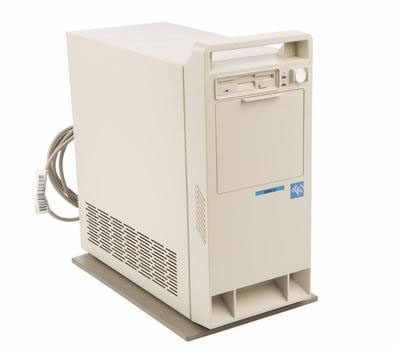
I distinctly remember reading in a magazine of this era, that if your computer didn't have a modem, it was basically a useless island. Which I felt was true- how much could you really do on a computer not connected to the outside world? At that time, I'd use the 2400 baud modem (in my aunts computer) to connect to one of the 60ish National Capital Freenet phone lines, (which disconnected you after a certain time and also within your daily time limit, to allow others an opportunity to connect and share the limited lines) to get connected.
Per NCF history info: “By the end of ’93, or maybe the beginning of ’94, we had 60,000 members,” Sutherland says. “That was huge, we were the biggest ISP in the country by a wide margin.”
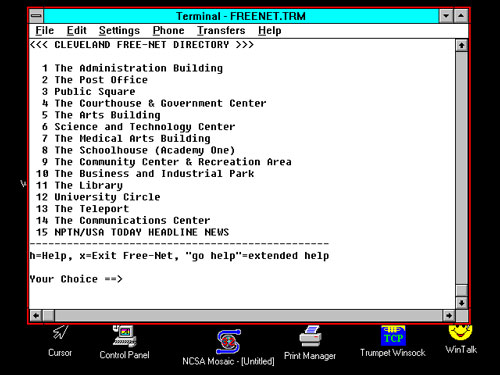
On NCF Freenet, you were presented with a text menu like that of the above from Cleveland Free-net. In terms of connecting with others who were online, you could get on "Usenet" where people would make posts chatting about certain topics. In my mind, Usenet was much like the modern day Reddit. The big thing for the time was that your posts on the certain topic weren't limited to who connected to a central server. Usenet was distributed among a set of news servers that stored and forwarded/replicated messages to one another around the world.
On a Freenet, you could also connect to other Freenets (typically hosted by major schools/universities) in different places and see their local content. That content might be really only relevant to the people of that geographic area, but was still absolutely fascinating to see what people were talking about in that area in almost real time. This was kind of an unheard of thing for the time, as the only way you'd get this kind of info would be by somehow obtaining a newspaper that was local to that area, or somehow watching a local- to that area- news tv channel. I do remember registering with a California FreeNet at the time to gain full access to its information, and they sent out a confirmation of it by regular old mail. I hope I kept that relic of a paper somewhere!
You could also get onto the WWW, albeit through text based Lynx browser only. At the time, I don't think you'd want to try to load images presented on the web anyway, at 2400 baud or even 9600. Maybe you would though, we were much more patient in those days. I do remember not even bothering with this method of connecting to the WWW other than to see if it were possible to navigate a page via text only!
Of course, email was another feature of having a Freenet account. Again though, there was a big difference between doing and having email back then, to these days. Now email comes to the device in your pocket, but then- if you wanted to check your email, you'd have to connect your computer to Freenet in your allotted time for the day and compete with others that may have wanted to connect too, at any given time. Then you'd very intentionally be checking your email or writing one up.
Some Freenets also allocated you a small amount of space for a WWW page - allowing you to have a web presence. On NCF, there was about enough disk space given for a background 'tile' image, maybe room for 1-2 decent quality small images... and of course your HTML. It was quite remarkable they did offer this web facing storage for free! Albeit your web address was something like http://www.ncf.carleton.ca/~aa000/
Freenets allowed you to chat in real time with others who were also on that particular Freenet. You learned to coordinate with or learned the schedule of when people you liked were "on". This is a big contrast to chatting today which happens on a device that follows you wherever you may go at any time of the day. Back then, we had to purposefully be on a computer and connected... and in chat, to "chat". It was a deliberate action to be somewhere to chat with others.
Yes- I'd say back then, you'd generally connect to a central service, and use that to connect out further. Freenet had connectivity to the WWW, email, other Freenets, Usenet, gopher, and local chat. AOL had its own ecosystem with access to the 'web' as well. An ISP provided WWW access, email, Usenet, and IRC chat. Now- its all just on the internet/www, rarely do you see other apps or protocols involved with being online outside of the almighty web browser.
Then was a time where you felt more connected to your local community (if even in a digital way) and you could take a step out into the larger world from there. Now- we omit what is going on locally, trading it for more sensational things going on at a global scale.
Actions then, were done with intentionality- as we chose when we wanted to do those things online, actions now tend to be done perhaps begrudgingly as the things online chase us down until we give them our attention. Times were different back then, surely!